
Case Study: Why Multiple Lenders Declined This Profitable Business Before We Secured £200,000
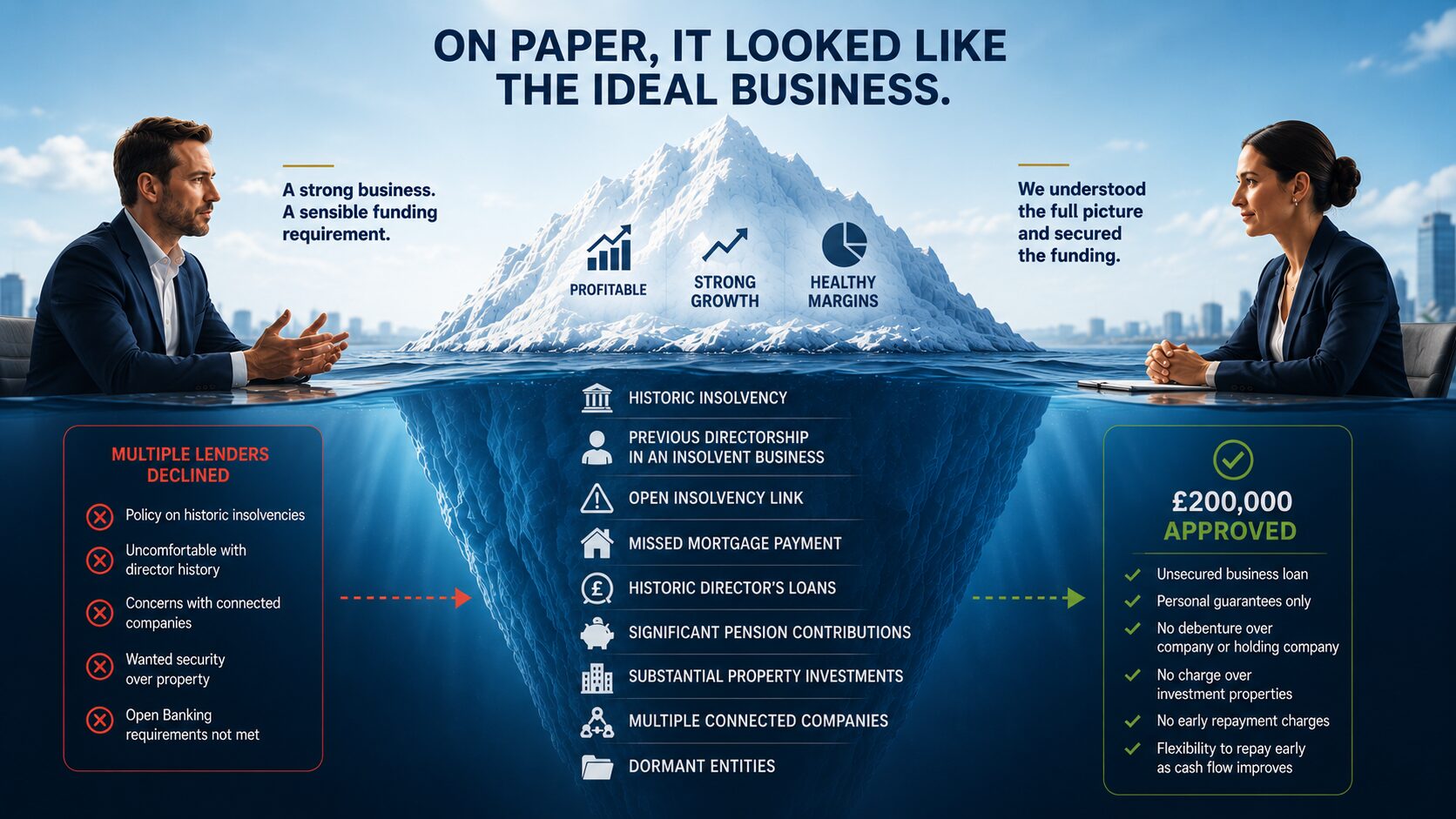
On the face of it, this looked like exactly the sort of business every lender wants.
The company was profitable, growing strongly and generating healthy margins. The directors had invested heavily back into the business and were purchasing larger office premises to support future growth.
The funding requirement itself was entirely sensible.
On paper, it looked like an ideal lending proposition.
It wasn’t.
Looking beyond the accounts
Commercial lending isn’t simply about turnover and profit.
Every lender has its own credit policy, risk appetite and interpretation of what constitutes an acceptable application.
As we carried out our market search, a number of historic issues began to influence underwriting decisions.
These included:
- An unrelated historic business insolvency connected to one of the directors.
- A previous directorship in another construction business that entered insolvency after the director had already left the company.
- That insolvency remaining open, meaning the director was still linked to an ongoing insolvency process.
- A recent missed mortgage payment appearing on a personal credit file.
- Historic director’s loan balances.
- Significant pension contributions.
- Substantial investment into commercial property.
- Multiple connected companies, including newly incorporated businesses and dormant entities.
None of these issues related to the current trading performance of the business.
However, together they created a far more complicated lending proposition than the financial statements alone suggested.
The investment strategy made perfect business sense
One of the most interesting parts of this case was that many of the issues lenders questioned were actually evidence of sensible long-term planning.
The directors had invested hundreds of thousands of pounds into commercial property.
They had also made substantial pension contributions to maximise available tax relief and were transferring property into a Small Self-Administered Scheme (SSAS) pension to create long-term tax-efficient wealth.
These decisions temporarily reduced available cash, increasing the short-term funding requirement, but they represented strategic investment rather than financial distress.
Understanding that distinction was critical.
Every lender viewed the case differently
As the application progressed, several lenders declined for entirely different reasons.
Some had automatic policies around historic insolvencies.
Others were uncomfortable with the combination of previous business failures and connected companies.
Some wanted security over multiple companies.
Others wanted charges over property.
One lender required Open Banking, which unfortunately could not be completed because the client’s bank did not support the required integration.
Every conversation uncovered another piece of the puzzle.
Finding the right lender
Eventually, we secured an unsecured funding offer.
The initial proposal was workable, but we believed it could be improved.
Rather than simply accepting the first set of terms, we negotiated directly with the lender.
We successfully removed the requirement for cross-company debentures.
We negotiated the facility down to personal guarantees only.
We also achieved a reduction in pricing and positioned the funding as a short-term working capital solution that could be repaid aggressively without early repayment penalties.
Although we were unable to increase the facility from £200,000 to £250,000, the lender confirmed that the amount reflected its maximum appetite after a full credit review.
The result
The client secured a £200,000 unsecured business loan.
No debenture over the operating company.
No debenture over the holding company.
No charge over investment properties.
No early repayment charges.
The facility provided immediate funding while preserving flexibility to refinance or repay early as cash flow improved.
Most importantly, it enabled the business to continue investing in its future.
Lessons for business owners
Strong businesses are not automatically easy to finance.
Historic directorships, credit reports, connected companies, property ownership, pension planning and previous business events can all influence lender decisions.
The key is understanding which lenders are likely to view those issues positively and which will decline automatically.
That is where an experienced commercial finance broker adds real value.
About Wise Commercial Finance
At Wise Commercial Finance, we provide businesses with access to more than 300 UK lenders, ranging from high street banks to specialist and alternative funders.
We arrange unsecured business loans, acquisition finance, invoice finance, revolving credit facilities, commercial mortgages, bridging finance, development finance and asset finance.
As an FCA-authorised Appointed Representative of Funding Friends Ltd, we work closely with both businesses and their professional advisers to structure funding solutions that match each client’s circumstances and future plans.
Whether you’re raising £50,000 or several million pounds, our role is to navigate the market, negotiate with lenders and secure the right funding on the best possible terms.